
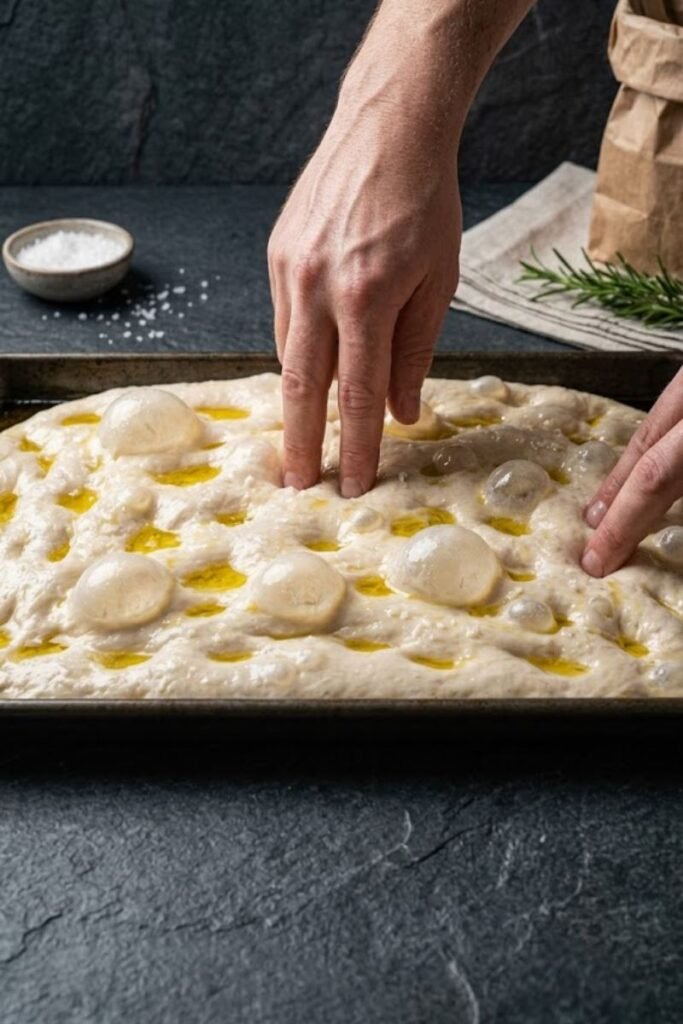
When I pull a blazing hot sheet pan out of my oven and marvel at a deeply blistered, golden-brown crust, mastering the physics behind air bubbles in focaccia bread is the ultimate structural victory that separates an airy, cloud-like slab from a dense, heavy brick of baked dough.
Over my years of managing high-hydration wheat frameworks and monitoring live yeast respiration windows, I have treated interior gas pockets as a direct thermodynamic and moisture design challenge with highly predictable kitchen rules.
Whenever I see amateur home bakers forcefully smash their open palms into a proofed pan of dough, it hurts the structure. Deflating the delicate gas chambers and wondering why their final flatbread bakes up thin, tough, and chalky shows how aggressive handling kills the structure.
For me, delivering those massive, translucent interior air pockets requires pushing your water weight metrics to an extreme threshold. Always execute a slow cold ferment and use a gentle finger-dimpling technique that pushes gas pockets upward without popping them.
Why Low Water Percentages Produce Flat, Heavy Crumb Mats
To understand why a basic single-day dough mix struggles to generate those coveted giant surface blisters, you have to look closely at the relationship between fluid weight percentages and gluten wall flexibility. Standard pizza and bread dough structures typically hover around a moderate 60% to 65% hydration scale, a tight molecular framework that provides an easily kneaded, non-sticky dough body that holds its shape on a baking peel.
If you try to use that exact same low-moisture base for a tray of flatbread, the dense, rigid gluten nets act like a tight rubber cage, completely constricting the natural gas expansions and keeping your interior crumb uniform, tight, and dry. True artisan focaccia requires you to break past those standard moisture limitations, forcing you to incorporate up to 80 grams of water for every 100 grams of strong bread flour.
This immense water volume turns the raw mass into a loose, shaggy slurry that feels sticky and completely un-kneadable under your hands. However, this high fluid content relaxes the glutenin protein networks completely, turning the cell walls into incredibly soft, highly stretchable membranes that can expand outward like a balloon without snapping back or tearing open.
The Cold-Fermentation Clock for Carbon Dioxide Saturation
My absolute baseline rule for cultivating giant gas pockets inside your baking pans relies on utilizing a slow, multi-day cold proof inside your household refrigerator. I follow the strict hydration charts, yeast respiration parameters, and fermentation temperature thresholds documented inside the official The Kitchn Focaccia Baking Directory to manage my dough structures safely.
When you mix a high-hydration dough and let it sit on a warm counter space, the ravenous yeast populations consume the flour sugars at a rapid, uncontrolled pace, forcing simple alcohol gasses to escape out through the wet surface before a strong cell wall can trap them. Sliding your oiled container straight into a cold forty-degree environment drops the yeast cells into a slow, semi-dormant state where they release carbon dioxide molecules at a highly measured pace over a 48-hour window.
Because cold water holds dissolved gasses significantly better than warm fluid, the slowly emerging carbon dioxide gas saturates the wet protein networks uniformly without escaping into the ambient air. I track these exact fluid gas-trapping boundaries carefully across all my high-volume flour projects, a moisture stabilization rule I prioritize when managing loose slipper loaves inside my guide on Focaccia vs. Ciabatta: What is the Difference in Dough Setup?.
The Piano Finger Dimpling Strategy to Lock in Surface Blisters
The final law for successfully shaping your highly aerated dough assets requires mastering a gentle, precise manual dimpling routine right inside your sheet pan before baking. Once your cold dough has spent a few hours warming up on your counter and has naturally stretched into every corner of your heavily oiled pan, the top layer will look like a soft, trembling mattress filled with delicate gas pockets.
Completely banish the use of flat palms, rolling pins, or heavy weights across this surface, as any crushing downward force will instantly pop the carbon dioxide cells and ruin days of fermentation work. Instead, dip your hands deep into a bowl of premium extra virgin olive oil to lubricate your skin, and position your fingers vertically like a musician preparing to play a heavy piano chord.
Press your fingertips straight down through the dough mass until you feel the cold metal floor of the pan beneath your pads, then pull your hands straight back up without dragging or sliding your fingers horizontally. This vertical displacement drives the trapped internal gas pockets sideways and upward into the narrow spaces between your fingers, gathering the loose bubbles into massive, glossy surface blisters that lock into place.
I know my handling execution is completely successful when the dimpled sheet looks like an active, bubbling spring covered in a glossy coat of seasoned oil and sea salt. Taking the extra two days to execute a cold ferment and manage your hand pressure is the ultimate kitchen secret to delivering an elite meal to your family table.