
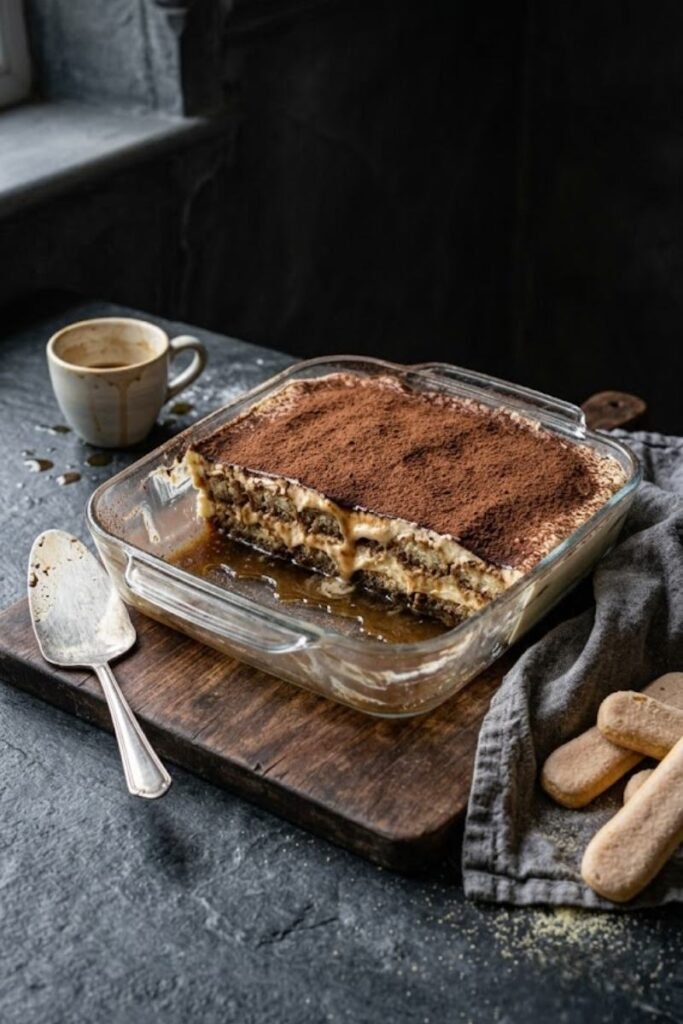
When I unclip the springform rim of a weekend dessert and watch a beautiful layered coffee cake collapse into a loose puddle, diagnosing exactly why did my tiramisu turn out liquid and runny is the ultimate structural skill required to save your pastry work from total ruin. Over my years of whipping raw dairy emulsions and folding delicate egg matrices, I have treated the stability of a cold mascarpone cream as a serious molecular engineering balance rather than a matter of basic mixing luck.
Whenever I see amateur home cooks rush through their assembly line, drowning their sponge biscuits in hot espresso pools or over-whipping their fresh fat tubs, I notice how a lack of moisture control ruins the dessert. For me, delivering a pristine, non-sagging slice requires monitoring how your structural proteins set so your layers remain perfectly defined under a knife.
Mistake 1: Drowning Ladyfingers in Hot Coffee Pools
To understand why a layered dessert collapses into a soupy soup base, you have to look closely at the high absorption rates of your dry sponge foundation. Traditional Italian Savoiardi biscuits are highly porous, dry foam cakes designed to act like edible sponges that rapidly draw up moisture layers when wet.
When you submerge these airy biscuits inside a bowl of steaming hot espresso for several seconds, the intense capillary action forces the liquid deep into the core cells, completely dissolving the fragile sugar and egg framework of the sponge. As the dessert rests overnight in the refrigerator, this trapped, excess coffee water slowly migrates outward, leaking directly down into your dense dairy layers.
This unchecked fluid migration dissolves your surrounding structural fats, leaving your beautiful cream sheets floating in a dark, watery puddle that cannot support its own weight on a serving spatula. I manage these exact moisture-bleeding boundaries constantly when balancing high-moisture Italian dairy tubs, a fluid-trapping baseline I track closely inside my guide on What Is Mascarpone Cheese? (And My Emergency Fixes).
Without these structural cell boundaries working effectively to lock the coffee in place, the excess liquid breaks down your carefully whipped layers, causing the cream to pool into a heavy, unappealing slurry that slides apart on the plate.
Mistake 2: Over-Whipping Dense Triple-Cream Matrices
The next major variable that destroys the structural integrity of your layered filling happens when an electric mixer is run on high speed for too long across a delicate bowl of fresh cream. Mascarpone is a highly concentrated triple-cream fresh cheese that carries an immense milk fat concentration hovering right around the 75% threshold.
I follow the strict lipid stabilization curves, whipping speed metrics, and mechanical handling boundaries documented inside the official The Kitchn Tiramisu Troubleshooting Guide to safely regulate my dessert density. When you beat this dense, sensitive fat matrix aggressively with electric beaters, the mechanical friction shatters the fragile membrane shields wrapping around the individual milk fat globules.
This cellular rupture forces the liquid whey to bleed away rapidly from the main fat body, causing the smooth cream to separate into a grainy, curdled slurry that liquefies instantly under its own weight. To bypass this structural breakdown, always use your machine’s lowest speed setting, or use a manual wire whisk to gently combine the ingredients just until the mixture achieves a smooth, matte sheen that holds a soft peak on your wooden spoon.
This gentle mechanical processing preserves the fragile lipid bonds intact, allowing the triple-cream cheese to maintain a thick, spreadable structural consistency that holds up against heavy ladyfinger moisture layers.
Mistake 3: Under-Developing Raw Egg White Air Pockets
The final law for achieving a sturdy, sliceable framework across your dessert requires mastering the delicate aeration mechanics of your egg foam expansions. The luxurious fluffiness of a traditional Italian pastry cream relies entirely on the mechanical power of raw egg whites whipped into a stable, air-filled foam matrix.
If you fail to whip your egg whites until they achieve a perfectly rigid, glossy, and stiff peak stage, the weak protein nets will lack the internal strength needed to trap escaping gas bubbles. When you attempt to fold a weak, watery egg slurry into a heavy mascarpone tub, the dense weight of the fats completely smashes the remaining air cavities.
Without a strong, air-filled protein web to lift the dense lipids, the entire filling collapses into a thin, pourable glaze that runs out the sides of your springform pan within minutes. I know my aeration process is completely successful when I can turn the egg white bowl completely upside down over my bench without losing a single drop of foam.
Taking the extra time to flash-dip your biscuits and regulate your mixing speeds is the ultimate kitchen secret to delivering an elite meal to your family table. This meticulous structural control guarantees your dairy cream layers maintain total physical fidelity, ensuring a crisp, uniform slice that stays perfectly vertical from the refrigerator shelf to the dessert bowl.